There’s one question that comes up in almost every initial meeting with local businesses and service providers: SEO or Google Ads – which delivers better results? The short answer is this: it depends on how much time you have, how much revenue you need to generate right now, and what profit margin you can realistically sustain. The useful answer—which is the one that really matters—requires looking at the business before the channel.
If you run a restaurant, a clinic, an estate agency, a law firm or any business that needs a steady stream of customers, choosing the right approach between SEO and Google Ads can save you months of trial and error, wasted money and a fair bit of frustration. It’s not about choosing whichever sounds best. It’s about understanding which tool best suits your current situation.
SEO or Google Ads: the real difference
SEO ensures that your website appears organically when someone searches for your services on Google. You don’t pay per click, but you do need time, a strategy and a solid technical foundation. It’s an investment that pays off over time.
Google Ads, on the other hand, allows you to appear at the top almost from day one by paying for visibility. It’s quick, measurable and very useful when you need to generate demand straight away. But that visibility depends on keeping your ad spend active. If you stop, you disappear.
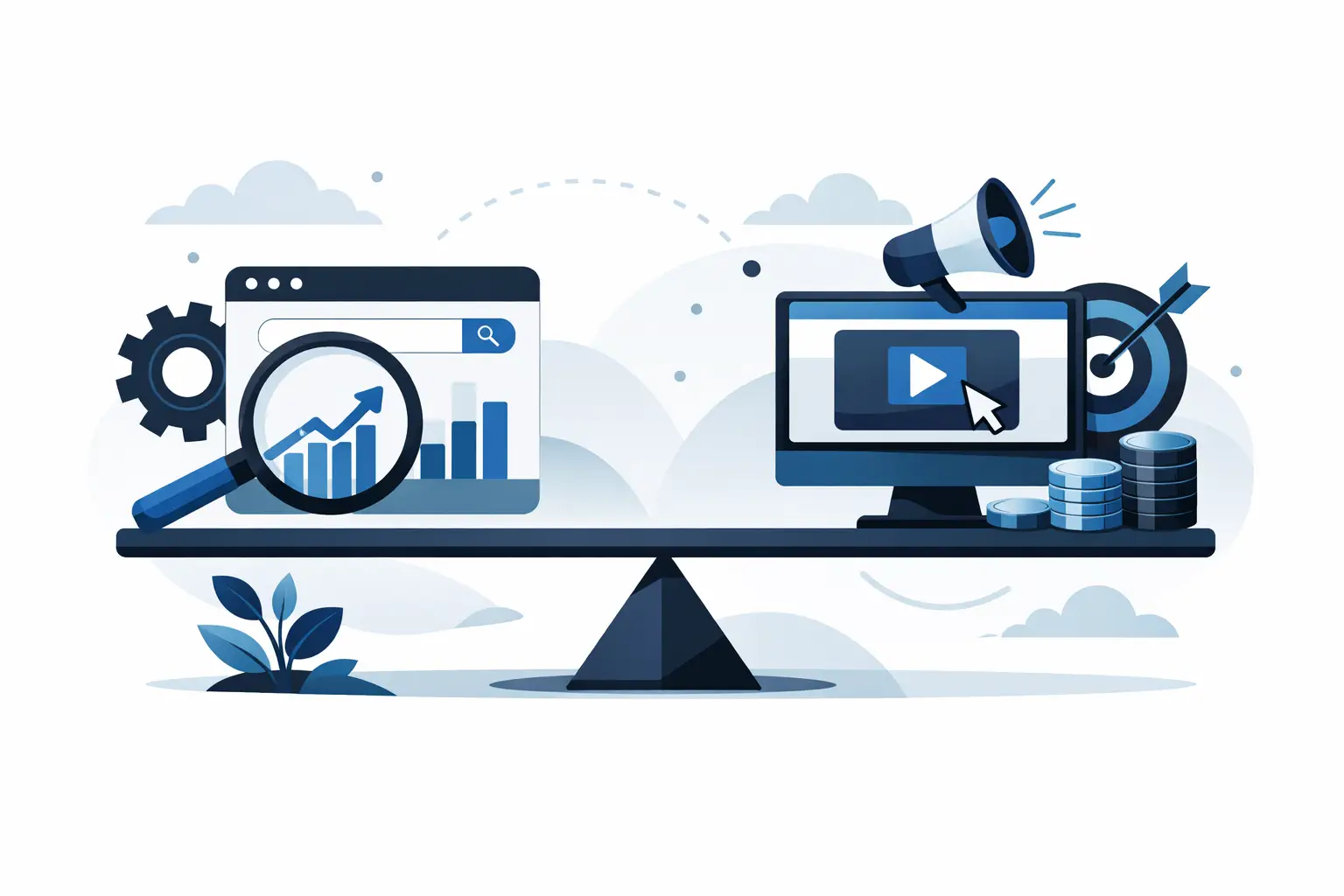
Put simply: SEO builds an asset; Google Ads buys attention. Neither is inherently better. Each has its place at a different stage of the business.
When is SEO most effective?
SEO is usually the best choice when you want to reduce your reliance on advertising in the medium term and build steady visibility. It’s also a great fit when your clients search on Google before hiring and compare various options. This happens every day with solicitors, dentists, cosmetic clinics, architects, psychologists, renovators, consultants and many local businesses.
The main advantage is that the work you’ve put in pays off in the long run. A well-ranked webpage can continue to attract visitors, calls and form submissions without you having to pay for every interaction. What’s more, it tends to inspire greater trust than an advert, particularly in sectors where users do their research before making a decision.
Let’s be clear about this: SEO isn’t a quick fix. If your website is slow, poorly structured, lacks useful content, or you’re competing in a highly competitive sector, results take time. And when an agency promises to get you to the top of the rankings in record time without analysing the competition, search intent and domain authority, you should be wary.
Local SEO, particularly useful for local businesses
For many SMEs in southern Spain, the Local SEO It makes a huge difference. If your aim is to appear in search results when someone searches for “dental clinic in Marbella”, “lawyer in Fuengirola” or “estate agent in Mijas”, there’s a very specific opportunity there. You don’t need to compete with the whole of the internet. You need to gain visibility within your local area.
In these cases, a well-executed SEO strategy does more than just boost traffic. It increases bookings, calls and quote requests from visitors who are genuinely interested in making a purchase. That said, this only works if the website is up to scratch. There’s little point in ranking a page that doesn’t convert.
When is Google Ads most suitable?
Google Ads It makes sense when you need results within weeks, not months. Whether you’ve just launched a website, are entering the peak season, need to fill your schedule quickly, or want to gauge whether there’s demand for a service, it’s a very powerful tool.
It’s also useful when searches have a clear commercial intent. If someone searches for “removal company Marbella price” or “Invisalign treatment San Pedro”, they’re much closer to making a booking than someone who’s just looking for information. That’s where a well-crafted advert can seize an immediate opportunity.
Another advantage is the level of control. You can adjust your budget, schedules, target areas, device types and keywords. You can pause, scale up or make adjustments quickly. This gives you the flexibility to make business decisions with less delay.
The problem arises when it is mismanaged. Campaigns lacking a strategy, overly broad keywords, generic adverts or weak landing pages cause the cost per lead to skyrocket. Google Ads isn’t a failure because it’s expensive. It fails when it’s used without sound business judgement.
Google Ads requires more than just setting a budget
Many people think that advertising is simply a matter of paying and appearing. It doesn’t work like that. To ensure a return on investment, you need to analyse search intent, segment campaigns by service, craft targeted messages and track which queries generate actual leads.
Furthermore, not all sectors have the same cost per click. In some niches, competing for certain search terms can be expensive, which means you need to fine-tune your strategy very carefully. Sometimes it makes more sense to target more profitable services or specific areas rather than trying to cover everything.
SEO or Google Ads, depending on your business situation
This is where the decision becomes a practical one. If your business needs leads right away because your schedule is empty or you’ve only just started, Google Ads is usually the quickest route. It allows you to drive customer acquisition whilst building a more solid foundation.
If you already have a basic framework, a decent website and the capacity to sustain a strategy for several months, SEO can offer you a more profitable return in the medium term. Especially if you want to rely less on pay-per-click advertising.
If your profit margin is tight, it’s also worth doing the maths before diving into Ads. There are businesses where the average spend per customer allows for aggressive campaigns, and others where every lead needs to be carefully targeted for it to make sense. It’s not just about how much it costs to acquire a customer. It’s about how much each customer brings in.
The best answer is often not to choose just one
Framing the debate in terms of SEO or Google Ads can be useful for organising your thoughts, but for many businesses, the smartest decision is to combine the two. Google Ads addresses the immediate need. SEO builds long-term stability.
Whilst adverts generate immediate demand, SEO gradually improves your organic presence so that, in a few months’ time, you’ll be less reliant on your advertising budget. What’s more, the two feed into each other. Ad campaigns can reveal which search queries convert best, and that information can be used to prioritise SEO pages with the greatest business potential.
The reverse is also true. If you already have well-crafted content and pages designed to drive commercial intent, your campaigns tend to perform better because users land on a more compelling website. When the strategy is well-integrated, the results are clear to see.
How to make the right decision without losing money
The question shouldn’t just be which channel you prefer. The right question is: what do you want to achieve first? If you’re looking for immediate visibility, proof of demand or quick lead generation, Google Ads has the edge. If you want to establish a stable position, reduce your long-term customer acquisition costs and build authority, SEO usually pays off more.
It’s also worth considering four factors before making a decision: urgency, budget, competition and the current state of your website. If you need results straight away, have the budget to invest and a well-prepared landing, Ads can get off to a flying start. If your budget is more limited but you can think in the medium term, SEO may be a smarter investment.
And there is another factor that is rarely stated clearly: execution matters more than the channel. Poorly planned SEO takes time and fails to convert. Poorly managed Google Ads burns through the budget. The difference lies not only in the tool itself, but in how it connects with the business, the offering and the page that the user lands on.
What we usually recommend to an SME or local business
For local businesses and service providers, the most sensible advice is usually to start with a realistic strategy. No grandiose promises. If the business needs customers immediately, it can activate Google Ads, focusing on profitable services and areas, whilst building an SEO foundation to sustain growth. If the business already has some traction and wants to consolidate its position, SEO can take on a greater role from the outset.
At AIRIS Agency, we see this all the time: when the strategy is tailored to the business’s current situation, the results come about more smoothly, with less stress and a better return. The important thing isn’t to sell you a channel. The important thing is to help you invest where it makes the most sense for your growth.
So, SEO or Google Ads?
If you’re looking for a definitive answer, I wouldn’t be honest. For some businesses, Google Ads is the catalyst that boosts sales from the very first month. For others, SEO is the best way to build a more stable and profitable customer base. And for many, the right mix of both is what makes all the difference.
The key is to stop focusing on meaningless metrics and start focusing on what really matters: more calls, more enquiries, more bookings and more sales. When you choose your channel based on that logic, the decision stops being confusing and starts to make sense.