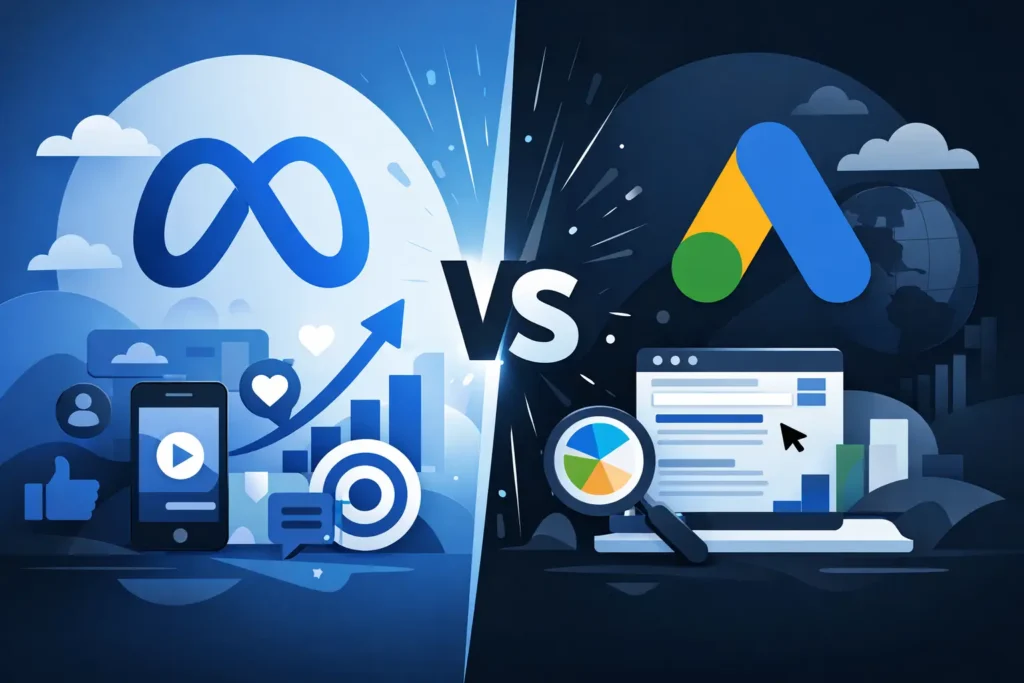
There’s one difference you’ll quickly notice in terms of results: with Meta Ads, you can generate interest among people who weren’t yet looking for you, whereas with Google Ads, you appear just when someone is already intending to buy, book or request a quote. That’s why, when a business is weighing up Meta Ads versus Google Ads, the real question isn’t which platform is better, but which one best suits their current situation, their budget and their business objective.
For an SME, a local business or a service brand, choosing the right channel can make all the difference between generating useful leads and wasting your budget on clicks that lead nowhere. And let’s be clear about this: there is no one-size-fits-all answer. However, there are situations where one option tends to work better than the other.
Meta Ads vs Google Ads: the key difference
Google Ads operates on the basis of existing demand. Users search for something, find an advert and click on it if the offer suits them. This makes it a very powerful channel for capturing direct intent. If someone searches for «lawyer in Marbella», «cosmetic clinic in Mijas» or «kitchen renovation in Fuengirola», they are quite close to making a decision.
Meta Ads works differently. It interrupts the user’s scrolling with a well-targeted and creative advert. It doesn’t wait for the user to search, but puts the offer in front of the right person. This makes it very useful for generating discovery, demand and brand recall. If you sell a service that requires an explanation, a visual demonstration or several interactions before a sale is made, Meta usually makes a lot of sense.
Put simply: Google captures intent, whilst Meta creates or accelerates it.
When Google Ads tends to deliver better results
If your business relies on searches with a clear intent, Google is usually the first serious option. This is particularly common for local services, urgent business needs, or sectors where the customer already knows what they need. A locksmith, a dental practice, a law firm, a removal company or an estate agent can benefit greatly from being visible at the exact moment of the search.
The big advantage is that they’re already close to converting. There’s no need to convince someone from scratch when they’re already interested. There’s less resistance and, in many cases, the lead is already more receptive. What’s more, local businesses, running search campaigns alongside a solid geographical structure and clear messaging can generate calls, form submissions and bookings fairly quickly.
That said, Google Ads isn’t magic. If there’s a lot of competition for a particular search term, the cost per click goes up. If the landing page doesn’t inspire confidence, the traffic won’t convert. And if there’s hardly any search volume for your service, no matter how good the campaign is, the volume will be limited.
When Meta Ads might be the best investment
Meta Ads really comes into its own when a service requires visual impact, interest-based targeting or a less immediate decision-making process. It works particularly well for beauty, wellness, hospitality, events, training, interior design and e-commerce, as well as for services where ‘before and after’ comparisons, testimonials or the value proposition are better understood through visuals than through text.
Another key advantage is the cost per reach. Even with a modest budget, you can introduce your brand to a large number of people in a specific area, which is particularly useful for local businesses looking to build brand awareness or promote a one-off offer. If you also make good use of remarketing, Meta allows you to engage with users right up until they decide to get in touch.
The problem arises when it’s used without a strategy. A nice-looking advert isn’t enough. If the offer is unclear, the targeting is poor or there’s no follow-up, the results suffer. Meta usually requires better creative work, more testing and more patience than Google to optimise effectively.
Which channel converts best?
The short answer is: it depends on the type of conversion and the customer’s stage in the journey.
Google Ads tends to perform better when a need already exists and the user is comparing options. In such cases, intent carries far more weight than visual impact. Meta Ads, on the other hand, can perform very well when the user needs several touchpoints before making a decision, or when the offer is triggered by impulse, desire or a sense of connection.
That’s why a business catering to urgent needs or high-intent searches will typically see better initial results on Google. Meanwhile, a personal brand, a beauty salon or a restaurant looking to fill its bookings may find Meta a more cost-effective way to generate interest, visits and bookings.
It’s not enough to simply measure the cost per lead. Sometimes Google generates fewer leads, but they are of higher quality. At other times, Meta generates more volume at a better price, but requires more effective lead qualification. The key lies not in the number of forms submitted, but in how many genuine opportunities actually result in a sale.
Meta Ads vs Google Ads depending on your type of business
If you run a local service-based business, Google Ads is usually a solid foundation when there is active search traffic in your area. It is particularly useful if customers need a specific, quick solution. Good examples include clinics, solicitors, locksmiths, renovation companies and garages.
If your business relies heavily on its image, on building trust over time, or on an aspirational offering, Meta Ads usually offers more scope. This is particularly suitable for sectors such as beauty, fitness, hospitality, interior design, events, and personal branding. It’s also very useful when you want to educate the market before making a sale.
If you’re selling high-value tickets or complex services, the best approach is often not to choose between one or the other, but to combine them. Google targets those who are already ready. Meta prepares, engages and re-engages those who haven’t yet taken the plunge.
The budget also changes the response
When budgets are tight, you have to be practical. If there’s clear demand on Google and a sufficient margin per customer, starting with search usually makes sense. The user is already close to converting, which shortens the journey.
If you’re working with a tight budget but your brand needs local visibility and your offering is visually appealing, Meta can deliver more impressions and insights for less money. That said, for it to really work, you need a straightforward approach, well-crafted creative content and a streamlined sales process.
With larger budgets, it’s usually a good idea to divide up the roles. Google to capture high-demand traffic. Meta to build brand awareness, run remarketing campaigns and open up new opportunities. That’s where the strategy starts to deliver greater results, rather than simply buying clicks.
The most common mistake: choosing a channel without considering the sales funnel
Many companies compare platforms without first reviewing their sales process. And that’s where they go wrong. It doesn’t matter whether you’re debating Meta Ads versus Google Ads if the advert then leads to a slow website, a generic landing page or a form that nobody responds to in a timely manner.
Advertising won’t fix a poorly conceived offering or a business that can’t turn attention into customers. What it does do is amplify what you already have. If your message is clear, your proposition is compelling and your sales follow-up works, the right channel can scale results. If not, you’ll simply be paying to expose internal problems more quickly.
So, before making a decision, it’s worth checking four things: whether your service has active search functionality, whether it makes a good visual impression, what your profit margin per customer is, and how long it takes a person to make a decision. That combination provides a far more useful answer than any generic discussion.
So, what should you choose?
If you need to attract customers who are already searching, Google Ads is usually the most straightforward option. If you need to generate interest, desire or brand recall, Meta Ads usually offers more scope. And if you want to build a more stable business model, combining both channels is usually the best approach.
At AIRIS Agency, we often see this with local businesses in southern Spain: the right platform isn’t the most well-known one, nor the one that worked for someone else, but the one that matches actual demand, the type of service and the current business objective. Some campaigns call for speed. Others call for patience. The best decisions come from understanding that difference.
The good news is that you don’t need to be everywhere; you just need to be in the right place with a message that drives people to take action. When that happens, advertising stops being an uncertain expense and starts to look like what it should have been all along: a tool for bringing in more customers, with fewer complications.