
In this article
The SEO for estate agents It is the work that ensures your agency appears on Google and Google Maps when a homeowner is looking for someone to handle the sale of their house or a buyer is searching for properties in your area, without relying solely on property portals. It is based on four key elements: the Google listing, one page per area, property listings that Google does not recognise as duplicates and, if you sell to overseas buyers, a version of the website in each language. Changes to the Google Maps listing and technical adjustments take effect within weeks; searches with more competition take months.
Below you’ll find what to do in each section, in what order, what to do with the properties sold, how much it costs, and two tools: a profitability calculator using your figures and a checklist to rate your website.
In summary
- What is it: Position your estate agency on Google, Google Maps and AI-powered answers to attract property owners and buyers without paying for each lead.
- Where to start: The Google listing and a lead-generation page for each area; these are what used to generate enquiries from property owners.
- The most costly mistake: publish the CRM listings as they are, with the same text as other agencies, and let Google index every combination of filters.
- On the Costa del Sol: In the second quarter of 2026, 37.01 per cent of property purchases in the province of Málaga were made by foreigners (Land Registrars). Without a website in other languages, that demand won’t find you.
What is SEO for estate agents, and how does it differ from that of other businesses?
Property SEO is organic search engine optimisation applied to an estate agency that has two different customers: the owner who wants to sell or let, and the buyer looking for a home. Each uses different search terms and needs a different page.
It also has three features that it does not share with a clinic or a restaurant: the portfolio changes every week (listings are added and sold), property portals account for a large proportion of the results for property searches, and, in coastal areas, a significant proportion of buyers search in English or other languages.
| Who is looking for | Search example | Page that should catch his attention |
|---|---|---|
| Owner selling | «sell a flat in San Pedro Alcántara», «get my house valued in Marbella» | Area-specific lead generation page with a rating and a short form |
| A landlord who isn’t familiar with estate agents | «estate agents in Nueva Andalucía», «estate agents near me» | Google listing and office page |
| Local buyer | «flats for sale in Estepona with a terrace» | Page showing the area and property type, with links to their details |
| Foreign buyer | «flats for sale in Marbella» | The same regional page in your language |
That is why the job is not about «ranking a website», but about deciding which page corresponds to each search query. This allocation forms the basis of the SEO for businesses on the Costa del Sol, and the following sections explain how to do this with or without an agency.
Is SEO worth it if I’m already paying for Idealista or Fotocasa?
Yes, because SEO and portals attract different customers. The property portal is the showcase for buyers who already know which property they want; your website is where a seller decides which estate agent to contact, and that’s where the portals hardly compete at all.
On a property portal, your advert appears alongside those of other estate agents who often list the same property. On your website and your Google listing, enquiries come directly to you, without having to pay for each featured advert. The sensible approach is to keep using property portals to attract buyers and to use SEO to attract property owners and for searches by area where the portals don’t have a good listing.
How to get your estate agency listed on Google Maps
To appear on Google Maps, you need a complete, verified Google Business Profile with recent reviews. Google explains that the Local ranking depends on relevance, distance and prominence: how well your profile matches the search, how close you are to the person searching, and how well-known your agency is – with reviews and ratings playing a key role.
This is the procedure we follow when dealing with an estate agent:
- Choose «Estate agency» as the main category and only include the secondary activities that you actually carry out, such as property management or holiday rentals.
- Enter the actual address of your office and your opening hours. If you do not receive clients at a physical premises, set up your listing as a service-based business.
- Choose from our range of services one by one: sale, letting, valuation, new-build or letting management.
- Upload real photos of the office, the team and properties sold – not stock images.
- Ask for a review at the end of every transaction, providing a direct link, and reply to all of them, including the negative ones.
- Use the same name, address and telephone number on your website, on online portals and in directories.
- Link the fact sheet to the office or area page, not necessarily to the home page.
If your office is in Marbella, bear in mind that people search for Puerto Banús, Nueva Andalucía and San Pedro Alcántara by name. For your estate agency to appear on Google Maps when someone searches for those areas, your listing must be physically located nearby, but your website must also clearly state which areas you cover.
Pages by area: what other websites can’t copy from you
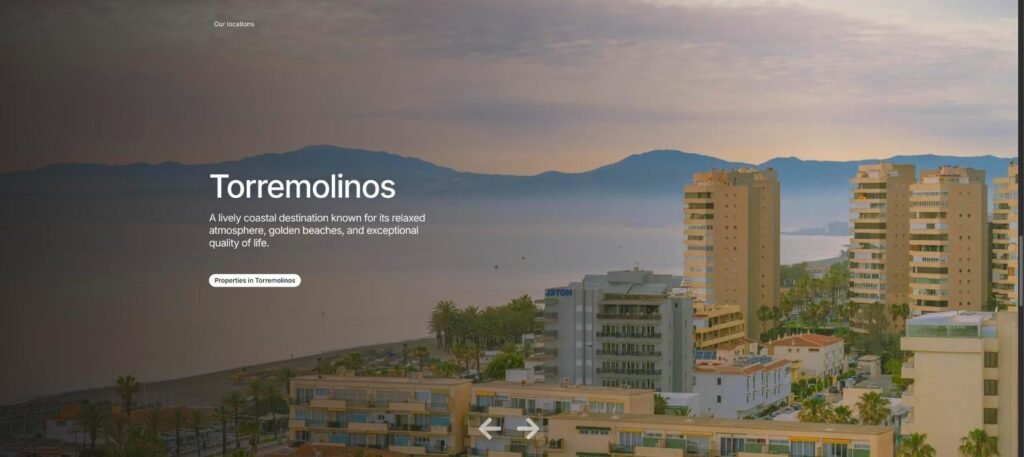
An area page is a URL dedicated to a neighbourhood or local authority area where you operate, containing useful information about that area and the properties you have listed there. It is the page with the greatest potential for SEO in the property sector because it addresses searches that the portal otherwise resolves with a generic listing.
A good local page includes:
- Your own description of the area: the main type of housing, amenities, schools, and distance to the beach or the airport.
- The properties you have in that area, linked and updated from the CRM.
- A registration form for property owners in that area, including a valuation form.
- The agent or office in charge, with a photo and telephone number.
- Frequently asked questions from people who buy or sell there.
Create pages only for the areas where you have a client base or wish to establish one. A hundred pages with the same text and just the name of the neighbourhood changed are what Google calls ‘doorway pages’, and they tend to do more harm than good. If the website needs to be redesigned, it is worth considering the web design for estate agents, with pages organised by area and available in several languages from the very beginning.
How to attract property owners via Google

To attract property owners via Google, you need a webpage that caters to the search needs of those looking to sell, rather than that of the prospective buyer. The owner searches for «sell house in [area]», «property valuation in [area]» or «estate agent in [area]», and almost never finds a website designed with them in mind.
A high-converting lead generation page has five elements: a headline mentioning the area, a brief explanation of how you operate (photos, marketing, viewings, negotiation), completed sales in that area (if you can showcase them), reviews from other property owners, and a valuation form with three or four fields. The more fields you ask for at the start, the fewer forms you’ll receive.
If you run a small estate agency and are wondering how to attract property owners via Google, start here: a lead-generation page for each key area and a well-optimised Google My Business listing. It’s less eye-catching than a blog featuring industry news, but it’s what brings in the enquiries.
Property listings: duplicate content, filters and sold properties

Property listings are the technical weak point of almost all property websites. There are three recurring problems:
The same text as that used by twenty other agencies
When a property listing comes from a CRM or a system shared between agencies, such as Resales Online on the Costa del Sol, the property description is identical across all the websites advertising it. Google usually displays just one version and filters out the others, so Rewrite at least the title and the first paragraph of the entries that matter most to you and add what only you know: direction, noise, community, the real situation.
Search filters
Each combination of filters (price, bedrooms, sort order) can generate a new URL. Google recommends control the tracking of URLs generated by the faceted navigation so that you don’t waste time on thousands of pages that are almost identical. In practice: index the pages by region and type, and exclude filter and sort combinations from Google.
Properties sold
A property that has been sold should not return a 404 error if the listing had views or links. This is the rule we apply:
| Status of the record | What to do | Why |
|---|---|---|
| Sold, with viewings or external links | Keep it labelled «Sold» and include links to similar properties in the area | It maintains traffic levels and serves as a trial to attract property owners |
| Sold, no viewings | 301 redirect to your zone page | Avoid mistakes and guide the user to something useful |
| Withdrawn by the owner | Remove it or redirect it to the area | It’s not a good idea to display something you no longer sell |
| A property that comes back on the market every year | Same URL, with changes to availability and price | The page accumulates history and links |
Does your estate agency need a website in English and other languages?

If you work on the coast, yes. According to the Property Registry Statistics for the second quarter of 2026, the foreigners did the 15.98 per cent of house purchases in Spain, an all-time high, and the 37.01 per cent in the province of Málaga, the second largest group after Alicante. Among the nationalities with the largest representation were British, Dutch and German nationals.
Translating your website isn’t enough. British buyers search for «apartments for sale in Marbella», not the literal translation of your headline, and each language has its own search terms and competition. Each version needs its own URL (for example, /en/ or /de/), content written specifically for that market, and hreflang tags, which Google uses to display the version of the page in each user’s language.
Prioritise the languages based on the buyers who are already contacting you, not on the list of flags provided by the plugin. Two languages done properly are more effective than six that have been automatically translated.
How to appear in ChatGPT when people search for an estate agent
To appear on ChatGPT, Gemini or Google’s AI Overviews, your estate agency needs the same things as for Google, but in a more explicit way: clear, consistent and easily citable data. These tools summarise web pages that are already well-ranked and complete Google Knowledge Graph entries.
On 16 November 2026, we asked ChatGPT how a Marbella estate agent could attract clients via Google. Most of the sources it cited were listings for specific properties on local property portals and agency websites, not articles about SEO. This suggests that the AI reads pages containing specific details about the area and the property itself. To stand a chance:
- Full Google listing, including services, areas and recent reviews.
- Local websites that answer the question asked by the buyer or the owner in the very first sentence.
- Structured data of the ‘RealEstateAgent’ type on the web, with a name, address and telephone number matching those on the listing.
- Answers with figures and dates: sale timelines, necessary documentation, costs involved in the sale.
How much does SEO for an estate agency cost, and how long does it take?
SEO for a property agency usually costs between €150 and €550 a month on a basic plan, and even more so if the website is available in several languages or has multiple offices, according to the published rates we analyse in our guide on the SEO prices in Spain. With AIRIS, the Basic plan costs €500 per month + VAT and the Pro package at €800 per month plus VAT; websites in multiple languages or with multiple locations are quoted on a bespoke basis.
As for timeframes, Google estimates that SEO improvements take between four months and a year to become apparent. For a property agency, the Google Maps listing and technical fixes become apparent sooner; local pages in competitive search results, later.
To find out if it’s worth it for you, use your own figures in the calculator. The figures shown are just an example: replace them with your agency’s figures.
Calculator: How much can SEO contribute to your estate agency?
Enter your details. The result is an estimate based on your figures, not a forecast of results.
Annual fees: 21.600 € versus 6.000 € for SEO.
Given these figures, SEO pays for itself through the business it generates.These figures aren’t the only thing that matters: check the traffic to your local pages or the conversion rates for your forms.
SEO checklist for estate agents: rate your website
Tick off what you’ve already done. Each item corresponds to a section of this guide; the ones you don’t tick are your to-do list, in order.
Checklist: Is your estate agency ready for Google?
10 points based on the sections of this article.
There’s some groundwork to be done: start with your Google listing and a lead generation page for your main area.You’ve got the basics sorted. The next step is property listings, filters and languages.Your website is well set up. Now it’s time to use Search Console to identify which areas are generating enquiries and to strengthen them.
Frequently Asked Questions about SEO for Estate Agents
How long does it take to see the results of SEO for a property agency?
Changes to Google Maps listings and technical corrections usually take a few weeks to become apparent. Local pages in competitive search results take months: Google says it can take between four months and a year to see the effect of the improvements.
Which keywords should an estate agency focus on?
Three groups: lead generation («sell a house in [area]», «property valuation in [area]»), agency-related searches («estate agent in [area]») and searches for properties by area and type («villas for sale in [area]»). On the coast, repeat this in each language using the terms that buyers in that area use.
Can I do the SEO for my estate agency myself?
The Google listing, reviews and the text on the local pages – yes. The technical side (filters, duplicates, languages, redirects for sold items) depends on how the website is built and usually requires someone who is familiar with the platform.
What should I do with the flats sold on my website?
If the listing had views or links, keep it with the «Sold» tag and links to similar properties. If it didn’t, redirect it with a 301 to the page for your area. Make sure it doesn’t end up as a 404 error.
Is it better for an estate agency to invest in SEO or Google Ads?
Google Ads brings in leads from day one and stops when you stop paying; SEO takes longer, but the results you achieve last. Many agencies use Google Ads campaigns to attract property owners whilst local listings climb the rankings.
What is property marketing?
Estate agency marketing refers to the range of activities an agency uses to attract owners to entrust them with the sale of their properties and to find buyers for those properties: website, SEO, property portals, advertising, social media and reputation management. SEO is the aspect that generates leads from Google without having to pay per click.
If you’d like to find out which areas and searches your estate agency can win, take a look at our plans SEO agency in Marbella Or write to us: we’ll review your website, your Google listing and your competitors, and send you a proposal setting out the plan and a fixed price before we start.