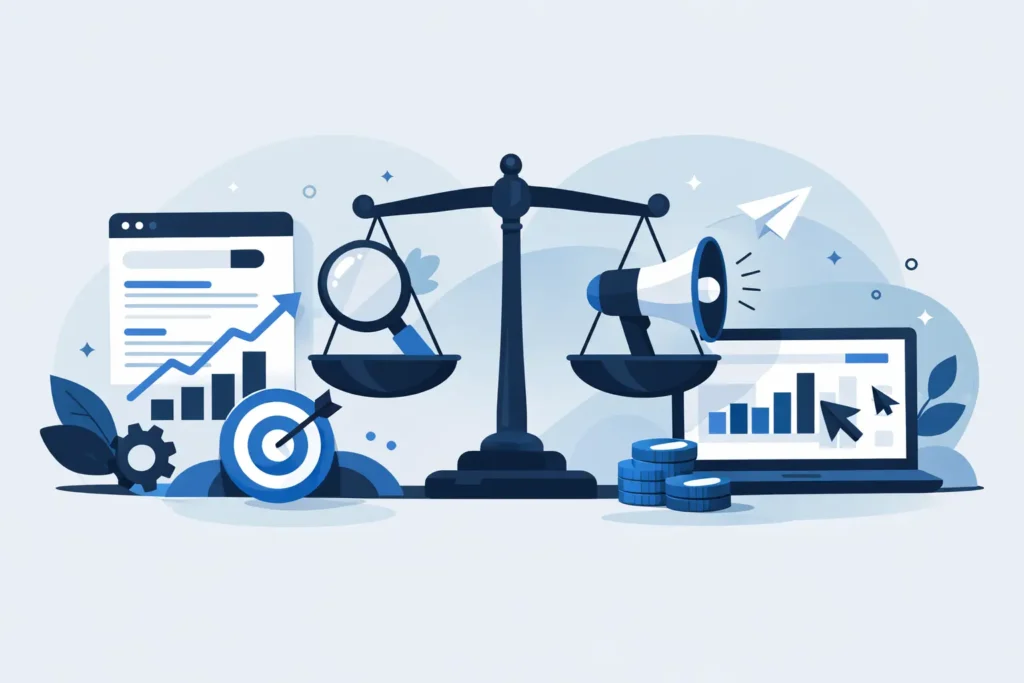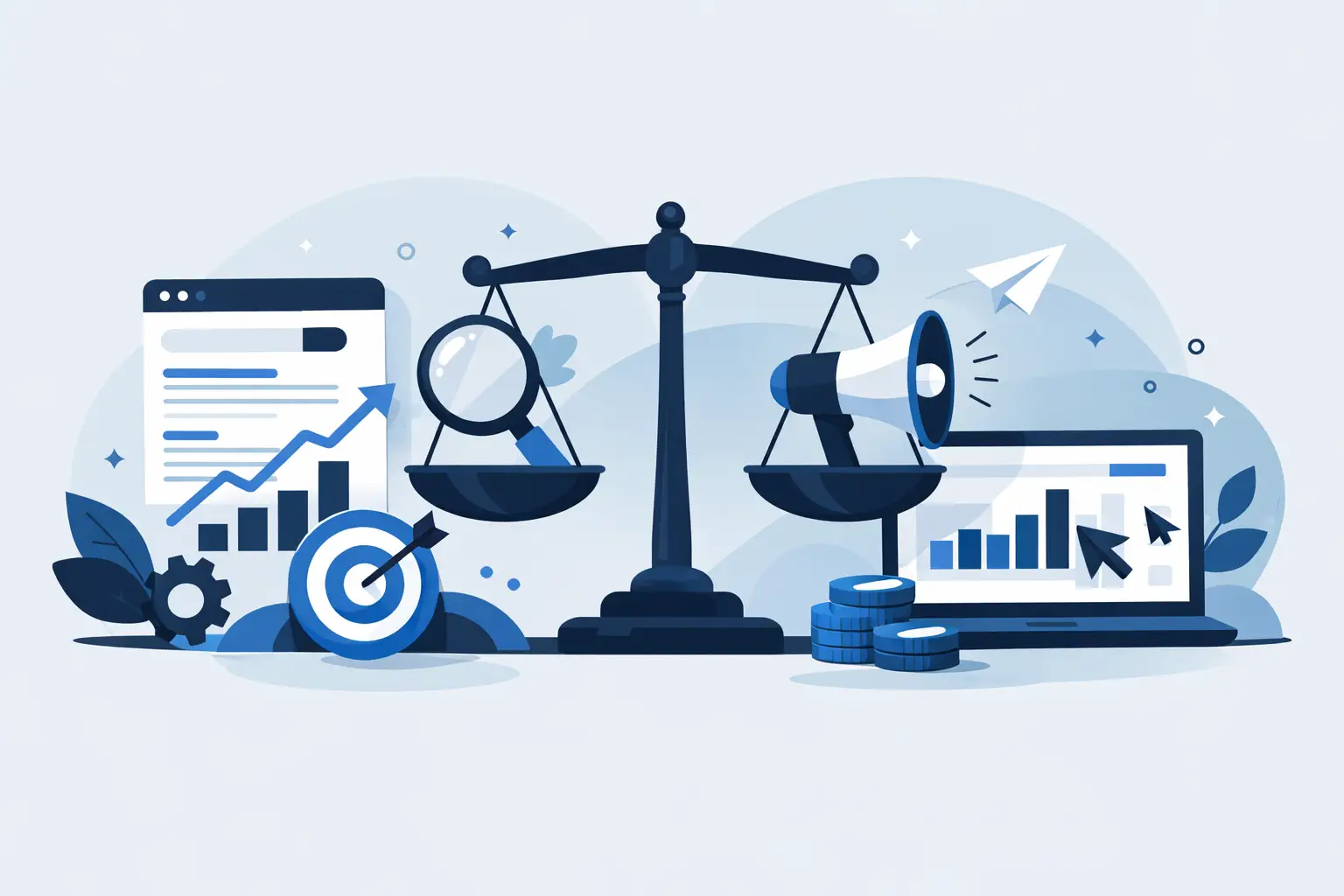
If you run a small business and need to attract customers within a reasonable timeframe, this isn’t just a theoretical question. Choosing between SEO and SEM for SMEs is a decision that affects your cash flow, your visibility and the pace at which your business grows. Making the right choice means you avoid spending months on strategies that aren’t suited to your current situation.
The short answer is this: there is no one-size-fits-all solution. Some businesses need quick results and should start with SEM. Others have the scope to build a stable and profitable channel using SEO. And many need a well-thought-out combination, not two strategies at odds with one another.
SEO or SEM for SMEs: the real difference
SEO works to improve your organic visibility on search engines. In other words, you optimise your website, your content, its structure and your authority so that you appear on Google without paying for each click. SEM, on the other hand, allows you to buy visibility through paid campaigns, usually on Google Ads, so that you appear right at the top of specific search results from the outset.
Put like that, it sounds simple, but the key difference isn’t just whether you pay or don’t pay. It lies in the time involved, in the control you have, and in the kind of return you’re looking for.
With SEM, you can launch campaigns today and start receiving traffic within a matter of hours or days. With SEO, results tend to take longer to materialise, but when the work is done properly, they can be maintained much more efficiently over time. One buys speed. The other builds an asset.
When SEM is usually the best choice
If you’ve just launched a website, need leads straight away, or have a marketing campaign with a specific deadline, SEM is usually the most logical approach. It also works very well for businesses with healthy profit margins and medium to high average order values, where paying per click can still be profitable.
Let’s consider a beauty clinic, a law firm, a renovation company or a seasonal tourism business. If someone is looking for that service today, appearing at the top of the search results with a well-organised campaign can lead to immediate calls, enquiries and bookings. Waiting months for SEO to take effect isn’t always a sensible option.
What’s more, SEM gives you a tactical advantage: it allows you to validate things quickly. You can see which searches convert, which messages attract the most leads and which pages perform best. That information is worth its weight in gold because it reduces the need to wing it.
However, there is a less pleasant side to it. As soon as you stop investing, you disappear. And if the campaign is poorly targeted, poorly measured or lands on a weak website, the budget is wasted without generating any real business. SEM does not forgive poor execution.
What an SME should consider before investing in SEM
It’s not enough just to have a budget. You need to have a clear proposition, a website designed to convert, and a proper system for tracking calls, forms and sales. If you don’t know how much it costs you to acquire a customer, you’re not doing marketing – you’re buying traffic blindly.
It’s also worth reviewing the search intent. Not all keywords are worth investing in. Some attract curious visitors, others those comparing options, and others people ready to make a purchase. This difference completely changes the return on investment.
When SEO is usually the best choice
SEO makes sense when you want to grow on a more solid foundation and rely on repeat searches within your sector. It is particularly effective for local businesses and service providers that need consistent visibility in their local area.
A clear example: a dental practice in Marbella, an estate agency in Mijas or a maintenance company in Cádiz. If there are people looking for these services every month, focusing on the Local SEO, service pages, technical optimisation and the website’s authority can generate a steady stream of opportunities without having to pay for every visit.
Another key advantage is trust. Many users still perceive organic results as more credible than adverts. They don’t always click on the first result that appears, but rather on the one that gives them the greatest sense of confidence. This is where a strong organic presence can set you apart from competitors who simply pay for visibility.
The problem is that SEO requires patience, good judgement and consistency. It doesn’t work as a one-off measure or a quick fix. If your website is poorly designed, your local listing is neglected, or you don’t have a content strategy or a clear site architecture, the results will take longer to materialise – or may not materialise at all.
What an SME needs to consider before investing in SEO
SEO is neither magic nor a game of tricks. It requires a sound technical foundation, content tailored to real search queries, and a medium-term vision. It also means accepting that, in highly competitive sectors, it is not enough simply to publish a few articles and wait for enquiries.
Conversely, when done properly, SEO reduces reliance on ongoing investment in advertising and improves the overall profitability of customer acquisition. Not because it’s free, but because it turns your digital presence into a more stable asset.
The right question isn’t which channel is best
The key question is this: what does your business need right now?
If you need quick results, to validate a proposal or generate immediate traction, SEM usually takes priority. If you already have a solid foundation, want to reduce your reliance on advertising and are looking for sustained visibility, SEO becomes more important. If your business wants to grow properly rather than constantly putting out fires, the usual approach is to combine both in a sensible way.
That said, combining channels does not mean duplicating efforts indiscriminately. It means using each channel for what it does best.
SEM can give you speed, data and opportunities right from the start. SEO can consolidate those profitable searches, strengthen the brand and improve the cost of acquisition over time. Together, they work particularly well when the strategy is driven by the business rather than marketing trends.
How to choose between SEO and SEM for SMEs without overcomplicating things
There are four variables that explain almost everything: timeframe, budget, competition and digital maturity.
If the timeframe is short, SEM has the edge. If the budget is very limited but you can sustain a strategy over time, SEO may be a more sensible option. If competition for adverts is fierce and clicks are expensive, it might be worth focusing on organic traffic. If your website isn’t converting well yet, investing in adverts before sorting that out is usually a bad idea.
Digital maturity is also a factor. An SME with an outdated website, lacking clear analytics, service pages and a well-defined business proposition, needs to get its house in order first. In such cases, it is often not a question of choosing between SEO and SEM, but of laying the groundwork to ensure that either approach can work.
A sensible approach for service-sector SMEs
In practice, many small businesses achieve better results when they start with highly targeted SEM campaigns, whilst at the same time building up their local SEO and the most important pages on their website. This enables them to generate demand in the short term and avoid getting stuck in a cycle of ongoing payments.
This balance is particularly useful for local businesses in southern Spain, where competition varies greatly depending on the area, the season and the type of service. Attracting bookings for the summer is not the same as generating leads for a complete refurbishment or appointments for a clinic throughout the year.
The most costly mistake: thinking in terms of channels rather than customers
Many SMEs waste time comparing SEO and SEM as if they were standalone products. But customers don’t think in terms of channels. They think about their needs. They search, compare, visit various websites, read reviews, check prices where available, and make their decision based on trust, speed and clarity.
That’s why there’s little point in positioning yourself or advertising if, afterwards, The website isn’t very convincing, the form doesn’t work or nobody responds promptly. The channel attracts customers. The experience converts them. Separating the two is costly.
This is where a well-executed strategy makes all the difference. It’s not just about getting clicks; it’s about turning searches into real business opportunities. And that requires measuring, adjusting and prioritising what actually delivers a return.
At AIRIS Agency, we see this all the time: companies that didn’t need more traffic, but rather a clearer strategy to turn their visibility into leads and sales. Sometimes that starts with SEO. Sometimes with SEM. And very often with a clever mix of both.
If you’re torn between SEO and SEM for SMEs, don’t look for a definitive answer. Look for the option that best suits your current situation, your budget and your business objectives. The right strategy isn’t the flashiest one, but the one that brings you closer to your next customers, faster and more effectively.